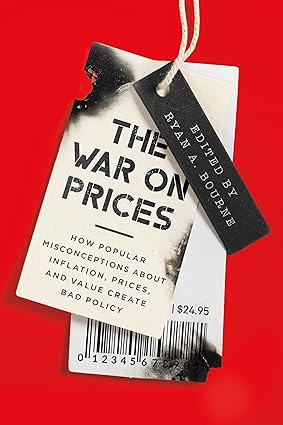
Today's Amazon Eye Candy is Ryan Bourne's book on various governmental efforts to obfuscate economic reality. (If you missed it, my report on Ryan's book is here.)
But it sort of sets the theme for a few items:
First up is Veronique de Rugy, who urges us to Judge the 'Populist' Push for Price Controls on Populist Grounds. After relating the various (very popular) efforts/demands to make goods and services "affordable":
Prices are the manifestations of countless decisions by buyers and sellers, each acting on individual knowledge no one else has. No buyer's budget and needs, and no seller's costs and offerings, are identical. Only a free market can account for this and decide whether a price sticks. Creating laws to cap prices doesn't make scarcity go away. It just shows up as empty shelves instead of a market-determined price.
Consider credit cards. A 10% interest rate cap sounds lovely. Many Americans pay twice that. Why not simply tell banks that's the limit? Because an interest rate isn't an arbitrary number. It is the price of credit that reflects funding costs, administrative expenses and, not least, expected default risks.
Congress can cap the rate, but it can't cap the risk. When the price a lender can charge falls below what the risk costs, lending stops. Lenders turn down applicants, cut credit limits and close accounts. The borrowers the cap was supposed to protect still need the money. They end up at the payday lender or the pawn shop instead. In other words, interest rate caps hurt the economically vulnerable people they are supposed to help.
Another scheme that won't work as claimed, as described by Tosin Akintola at Reason, is Ruben Gallego's plan to save America's middle class: Higher taxes and more unions.
In a 32-page plan unveiled Wednesday, Sen. Ruben Gallego (D–Ariz.) claims that the American dream is being blocked by officials who have "let billionaires and giant corporations create our unbalanced economic system." To "rebuild" America's middle class, Gallego calls for establishing "a New Deal–style public service jobs program" that "funds jobs that allow AI-displaced workers to help families and serve communities."
And that might be the tamest idea in this sprawling populist platform. It's unlikely that any of Gallego's plans will actually be signed into law anytime soon. But his proposals do provide some insight into what policies progressive candidates could be offering in 2028.Gallego's plan calls on the government to mandate higher pay rates for overtime and holiday work, expanded unemployment insurance, and sick, vacation, and family leave. He wants higher taxes on capital gains, plus a new "corporate 'robot' tax" to discourage companies from using automation. He would "require employers and workers to bargain over workplace technology," ostensibly placing employees on equal footing with owners in deciding the direction of a private enterprise.
Indeed, to "protect workers," Gallego would consider banning "complete automation," would place "hard caps on technology deployment," and would institute requirements for "human operators." While that might protect jobs in the short run, it could cripple the companies that employ many of those workers—autonomous ride-sharing and delivery companies, of course, and also the autonomous manufacturing companies critical to the aerospace, healthcare, software, and defense industries.
The best of intentions! What could possibly go wrong?
Well, I can think of one thing: If you tax robots, won't they start pointing out the pre-Revolutionary War slogan, "No Taxation Without Representation!" And before you know it, it's Terminator time.
Which brings up another peeve: my weekly trip to the Rollinsford Town Dump
Transfer Station, where an irritating sign reminds me
that the "Live Free or Die" motto on my license plate doesn't apply there: recycling is mandatory!
If only they would read Bjorn Lomborg's WSJ column: Most Recycling Is a Waste. Nevertheless, the eco-craziness is international in scope. And (as usual with government), there's the arrogant assumption that the citizen labor involved is "free":
Official accounts ignore a cost every household pays: the time spent sorting. Peer-reviewed studies from Sweden and Finland find it takes 26 to 29 minutes a week per person. Value that time at half the minimum wage in each country and it comes to €43 billion to €47 billion a year across the EU, about as much as the entire cost of Europe’s municipal waste system. Across the Organization for Economic Cooperation and Development’s member states, it amounts to $111 billion to $123 billion.
Recycle what is worth recycling. Then throw away the idea that more recycling is always better.
But, as our headline says, it's war. And in war, truth is the first casualty. So I'm not hopeful that my town's mandate will be going away in my lifetime.
Also of note:
-
La guerre, c'est la paix ; la liberté, c'est l'esclavage ; l'ignorance, c'est la force. Jonathan Turley notes the bad news about France: Macron Goes Full Orwell: The French President Makes One More Pitch for Censorship.
French President Emmanuel Macron went full Orwell this week. While long the darling of Western media, Macron has been one of the most anti-free-speech leaders in the world. This week, he declared that “The so-called American ‘free speech’ today, which some people have promoted, is the opposite of free speech.” Having Emmanuel Macron holding forth on free speech is akin to Joey Chestnut proselytizing on veganism.
France has been in a headlong plunge into censorship and speech criminalization. These laws criminalize speech under vague standards referring to “inciting” or “intimidating” others based on race or religion.
For example, fashion designer John Galliano has been found guilty in a French court on charges of making anti-Semitic comments in a Paris bar.
Can you think of a worse idea than putting governments in charge of deciding what speech will be allowed?
Gee, I wonder what Nina Jankowicz thinks about all this?
Well, her American Sunlight Project (still) seems moribund. The latest output on its "Research" page is from September 2025.
Ah, but she has a Substack! And it's a little more active. I could find no reaction to Macron's antics there, but a few days ago she reported cheerfully reported that The UK Gets Serious About Countering Disinformation. She pooh-poohs Nigel Farage's contention that the UK's "National Centre for Information Defence" will be used to "clamp down on free speech.” Not at all, Nina says. It will only focus on Russian disinformation campaigns!
Gee, that couldn't happen here.
Meet your new head of the Homeland Security Disinformation Governance Board, America https://t.co/l1s9BtJ6DO
— Jack Posobiec (@JackPosobiec) April 27, 2022
-
Nothing to worry about here! Jim Geraghty notes the ‘High-Risk Research’ and ‘Shoddy Biosafety Measures’ at Russian Plague Lab.
The World Health Organization finally offered a brief statement about the dead Russian plague researcher; CNN reported this morning:
“If they’re not transparent, if they’re not open to independent accountability, how is it possible to trust the Kremlin is telling us the full and accurate information?” said Lawrence Gostin, a global health law professor at Georgetown University who has worked closely with WHO. “Clearly, on its face, the lab was conducting extremely high-risk research and using shoddy biosafety measures.”
“Extremely high-risk research and using shoddy biosafety measures.” Boy, where have we heard terms like that before?
Well, maybe we'll have more cheerful news tomorrow.


