Here at Pun Salad, We Continue to Hope for Fiscal Sanity, Honest Politicians, Rational Voters, and a Pony
One year ago, Hamas launched a horrific attack against Israel, killing over 1,400 Israeli citizens – including defenseless women, children, and the elderly – and kidnapping hundreds more. Today, the prospects of peace seem more distant than ever. But we continue to hope for a…
… return of all the hostages, an end to the violence, a rejection of hate, and a future in which both Israelis and Palestinians can enjoy the security and stability that most of them yearn for.
"… and a pony."
Ah well, I guess his heart is in the right place. Which I also guess was the point of his tweet: to show
that his heart was in the right place.
Alas, not everyone is getting the message of peace and love. Jim Geraghty views
recent anti-Israel protests and concludes:
The Antisemitism Is the Point.
This planet is full of people who just want to kill Jews, and this country has no shortage of people who just want to cheer on the murderers.
Anybody on campus want to march in the quad about that?
The local TV station, WMUR,
notes the local
festivities:
The University of New Hampshire's Palestine Solidarity Coalition held a gathering in Durham on Monday to honor Palestinian lives.
The event was part of the group's "Week of Rage," which commemorates the 41,000 people killed on Oct. 7, 2023.
Ah, nothing "honors" Palestinan lives more than a "week of rage".
Quibble: the "41,000" number is wrong, of course. It is similar to the number of Gaza fatalities
reported by the Gazan "health ministry" since 10/7, according to
Forbes. And that doesn't count Israeli dead on 10/7.
As Geraghty notes, there's no indication that Uyghur, Ukrainian, or (of course) Israeli lives were
mentioned, let alone honored. And what the "Solidarity Coalition" actually says is…
Join us next week to protest one year of the Palestinian genocide and mourn the loss of life and liberty that has been deemed acceptable by the United States, Israel, and Western medias. We will not stand idly while more massacres unfold!
There are two basic debates about AI. One is the “AI safety” or “X-risk” debate, which is about whether AI will turn into Skynet and kill us. But the most prominent and common debate is about AI taking jobs away from humans. What’s interesting about this debate is that practically everyone involved, from AI’s biggest boosters to its biggest critics, seems to agree on the basic premise — that the primary function of AI is as a direct replacement for human beings. In general, people only disagree about what our reaction to this basic fact should be. Should we slow down AI’s development intentionally? Should we implement a universal basic income? Should AI engineers and their shackled gods retreat behind towering fortress walls guarded by legions of autonomous drones, letting the rest of humanity suffer and die as GPT-278 sucks up all of the world’s energy for data centers?
Coercive policy regarding COVID vaccination, recommended by Fauci on the false premise that vaccinated people could not get or spread the virus, collapsed public trust in other vaccines and led the media and public health officials to gaslight individuals who had suffered legitimate vaccine injuries. To pay for the lockdowns recommended by Fauci, the U.S. government spent trillions of dollars, causing high unemployment in the most locked-down states and a hangover of higher prices for consumer goods that continues to this day. Who is to blame?
Fauci served as a key adviser to both President Donald Trump and President Joe Biden, and was a central figure on Trump's COVID task force that determined federal policy. If Fauci has no responsibility for the outcomes of the pandemic, nobody does. Yet in his memoir's chapters on COVID, he simultaneously takes credit for advising leaders while disclaiming any responsibility for policy failures.
Fauci implausibly writes that he "was not locking down the country" and "had no power to control anything." These statements are belied by Fauci's own bragging about his influence on a host of policy responses, including convincing Trump to lock the country down in March 2020 and extend the lockdown in April.
Bhattacharya co-wrote the "Great Barrington Declaration", which Fauci loudly opposed, and
still does. I think Bhattacharya has the better argument here.
The botched plea deal with Khalid Sheikh Mohammed and other 9/11 terrorists is a signature Biden-Harris administration moment: a scheme, apparently double-wrapped in incompetence, to spare the Democrats’ presidential candidate — first the senescent one, then the vacuous one — from an unpopular political decision.
I say double-wrapped because it appears the deal that the administration made, and since then has desperately tried to renege on, contains an anti-renege clause — one that officials calculated would frustrate Donald Trump but on which, instead, the administration has tripped itself up.
Back in August, I outlined how the Biden-Harris administration traded a political problem for a legal problem. The political problem is that the 9/11 case, which has lingered for over two decades, probably cannot be ended unless the administration permits the Defense Department to take the death penalty off the table in order to induce a guilty plea from the terrorists; yet, because the terrorists killed nearly 3,000 Americans, removing capital punishment would be extremely unpopular — and thus the administration does not wish to do it, or at least be seen doing it, much less try to explain it.
As we have seen, the progressive Democrats who run the administration love to make the base swoon by brandishing their anti-death-penalty credentials in the abstract. When it gets down to real cases, though, they hide under their desks: Not only is capital punishment patently constitutional; the majority of Americans approve of it in heinous cases, particularly jihadist mass-murder cases. So, Biden and Harris play a game. They airily proclaim philosophical opposition to capital punishment. In concrete cases — such as that of Boston Marathon bomber Dzhokhar Tsarnaev — they tell the country they are defending the death-penalty sentence ordered by a jury; but in so doing, they quietly assure Democrats not to worry because they have imposed a moratorium on executions, ensuring that no death sentences will actually be carried out.
Might be amusing to hear Queen Kamala of Word Salad explain that one. But then someone would have to ask her about it, right? Dream on . . .
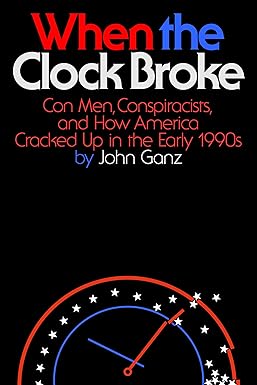
Con Men, Conspiracists, and How America Cracked Up in the Early 1990s
(paid link)
I picked up this book from Portsmouth (NH) Public Library mainly due to
this review
from Brian Doherty at the Reason website. (I don't think it made it into
the magazine.) Doherty called it "a solidly educational and entertaining work of political history."
Ganz's implicit thesis: the early 1990s were an important part of the story of
How We Got Here, thirty years later.
But, really, you can say that about any period in American history, can't you?
Ganz focuses on personalities of the period, mostly ones he finds colorful, outrageous, or dangerous.
As Doherty notes, he spends a lot of words on Murry Rothbard, concentrating on his flirtation
with paleoconservatives. The book's title is from a Rothbard speech; you can also find
it in
one of his long-winded articles
from the Rothbard-Rockwell Report, reproduced by the Mises Institute. And it's in
response to the cliché "You can't turn back the clock."
We shall break the clock of social democracy. We shall break the clock of the Great Society. We shall break the clock of the welfare state. We shall break the clock of the New Deal. We shall break the clock of Woodrow Wilson’s New Freedom and perpetual war. We shall repeal the 20th century.
As Doherty also notes, despite Ganz's title, this did not come close to happening.
Anyway, Ganz's history is wide-ranging and (you might argue) idiosyncratic. In addition to
Rothbard, Ganz looks at folks like David Duke, Bo Gritz, John Gotti, David Dinkins, Rudy Giuliani,
Rush Limbaugh, Jesse Jackson, …
And, naturally enough, the major figures of the 1992 presidential campaign: George H.W. Bush,
Bill Clinton, Ross Perot, Pat Buchanan.
Anyone remember Clinton's "Sister Souljah" moment?
Ganz does. Were you aware that a professor named Caroll Quigley
had an inordinate influence on Bill Clinton's philosophy? I didn't, but
Ganz spends many pages on exploring that.
And Ross Perot was a holy terror back then about the deficit and associated national
debt. Why, we were adding "$1 billion in debt every 24 hours"!
Reader, according to
these folks,
over the past year, the debt averaged a $6 billion increase per day.
One little sentence on page 20 jumped out at me, and I fear it colored my attitude toward the book:
During the presidential campaign of 1980, Ronald Reagan campaigned against "welfare queens."
Uh, reader, no he did not. I blogged about this
ten years ago
(heavily relying on
this Reagan-hostile Slate article). As near as anyone can tell, Reagan used
the term "welfare queen" (not "queens") once, in 1976 (not 1980), during one of his radio addresses. And he was quoting
the term used in a Chicago Tribune story about Linda Taylor, an actual person.
I noticed a few other drive-by mini-slanders throughout, unsourced. If you're tempted to repeat any of 'em as
gospel, caveat lector.
But another unsourced and widely repeated factoid on page 189: Gene Roddenberry was the speechwriter
for LAPD chief William Parker in the 1950s, and based Star Trek's Mr. Spock on him. I didn't know
that! And it might be true!
Disclaimers:
Unquoted opinions expressed herein are solely those of the
blogger.
Pun Salad is a participant in the Amazon Services LLC Associates
Program, an affiliate advertising program designed to provide a
means for the blogger to earn fees by linking to Amazon.com and affiliated sites.

![[Amazon Link]](/ps/asin_imgs/0593657470.jpg)

![[The Blogger and His Dog]](/ps/images/me_with_barney.jpg)


